
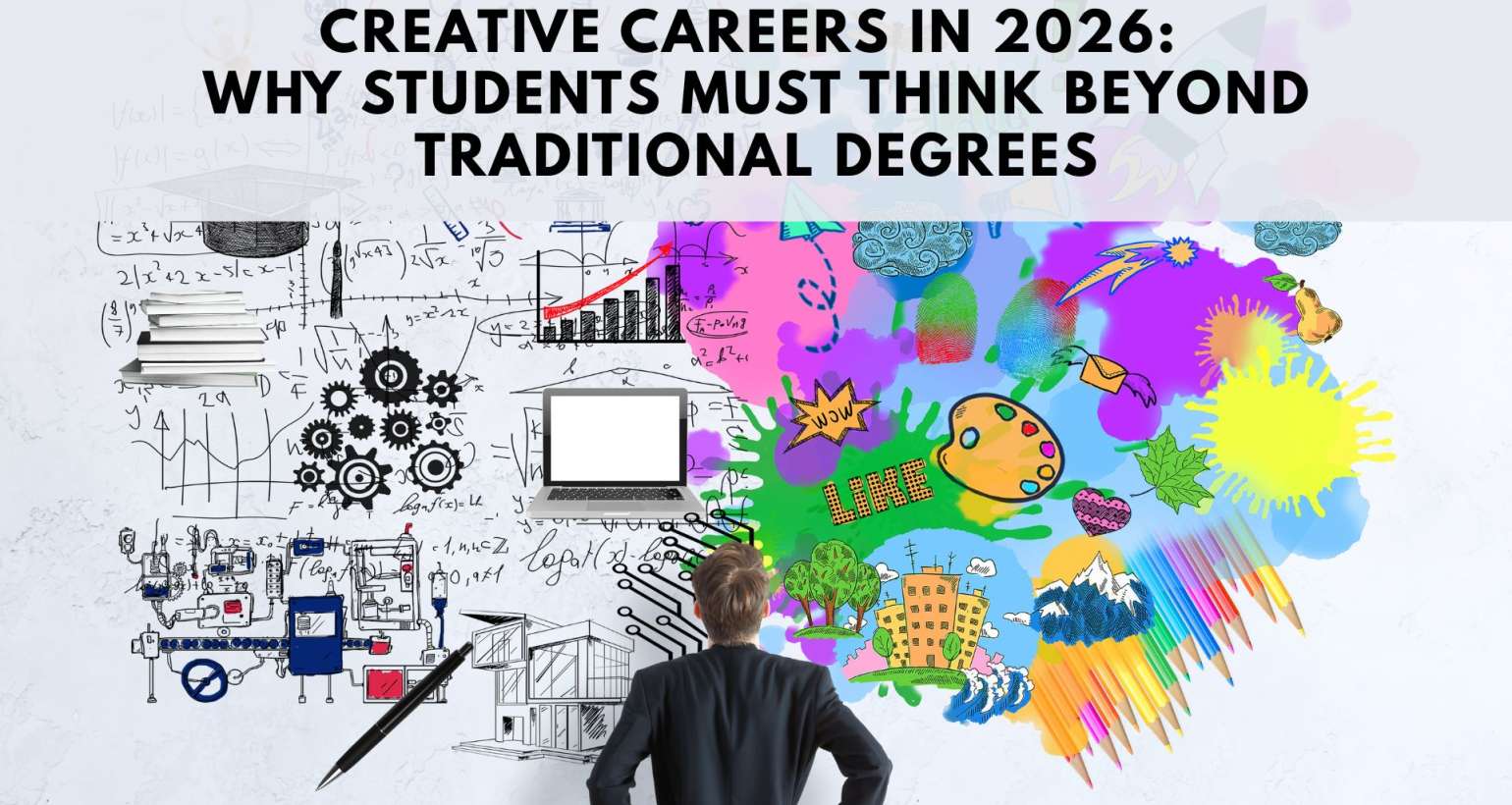
For years, students were taught to follow a predictable formula: choose science, commerce, or humanities, secure high grades, pursue a conventional degree, and eventually settle into a stable profession. However, the world students are stepping into today looks very different.
Industries are changing faster than ever. Ar0tificial Intelligence is reshaping the way businesses work. Creative fields are no longer viewed as ‘alternative’ careers. Employers are increasingly looking for individuals who can think critically, communicate ideas effectively, adapt quickly to change, and solve problems creatively.
As a result, students and parents across India are beginning to ask an important question:
What skills and careers will actually matter in the future?
At EdNet Consultants, we have been seeing a major shift in the aspirations of students applying to universities across the world. Increasingly, students are moving toward interdisciplinary and future-focused fields that combine creativity, technology, business, psychology, media, design, entrepreneurship, and innovation.
The future no longer belongs only to students who memorise information. It belongs to students who know how to think.
The Rise of Interdisciplinary Careers
One of the biggest educational trends globally is the rise of interdisciplinary learning.
Students today are no longer limiting themselves to one narrow career path. A student interested in fashion may also study marketing and consumer psychology. Someone passionate about gaming may explore coding, storytelling, animation, and user experience design together. A business student may combine entrepreneurship with sustainability and technology.
Universities worldwide are redesigning their programmes to reflect this reality.
Institutions such as New York University, Parsons School of Design, Rhode Island School of Design (RISD), University of the Arts London, King’s College London, and Northeastern University are increasingly encouraging students to work across disciplines rather than remain confined to a single one. This is because industries themselves are becoming collaborative.
Today, successful professionals are expected to:
- Think creatively
- Communicate effectively
- Understand technology
- Work across cultures
- Adapt quickly
- Solve real-world problems
These skills cannot always be developed through traditional rote-based education alone.
Why Creative Careers Are Growing Rapidly
One of the biggest misconceptions in India is that creative careers are ‘unsafe’ or ‘unstable’. However, global hiring trends are showing the exact opposite.
Fields like:
- Design
- Animation
- Filmmaking
- Fashion Communication
- UX/UI Design
- Digital Marketing
- Creative Technology
- Game Design
- Architecture
- Media & Communications
- Branding
- Content Strategy
- Product Design
- Creative Entrepreneurship
are now among the fastest-growing industries globally.
The digital economy has completely transformed how brands communicate with audiences. Companies today are not only hiring engineers and analysts; they are also actively seeking storytellers, strategists, designers, creators, and innovators who can humanise technology and build emotional connections with consumers.
Even Artificial Intelligence, despite automating many technical tasks, is increasing the value of uniquely human skills such as originality, compassion, observation, communication, and creative thinking.
This is exactly why universities are now placing stronger emphasis on portfolios, projects, internships, research, collaborative learning, and real-world exposure.
The Importance of Exposure Before University
One of the biggest mistakes students make is choosing a course or career path without actually understanding the industry behind it.
Many students decide to pursue psychology, business, design, architecture, law, or media simply because of social media trends, peer influence, or a surface-level understanding.
But true career clarity comes from exposure.
Students need opportunities to:
- Explore industries practically
- Interact with mentors
- Build portfolios
- Attend workshops
- Participate in internships
- Engage in competitions
- Experiment creatively
- Understand real-world applications of subjects
This is why summer schools, immersion programmes, mentorship initiatives, and profile-building opportunities have become increasingly important in the admissions process.
Top global universities are no longer evaluating academic scores alone.
They are looking closely at:
- Intellectual curiosity
- Initiative
- Leadership
- Depth of engagement
- Creative thinking
- Problem-solving ability
- Community impact
- Authenticity
Students who actively explore their interests beyond the classroom often develop much stronger university applications as well as greater confidence in their own direction.
How AI Is Changing Education and Careers
Artificial Intelligence is undoubtedly one of the most discussed topics in education today. Parents often ask whether AI will replace jobs entirely. Students worry that the careers they choose today may not even exist tomorrow.
The reality, however, is more nuanced. While AI is changing industries, it is also creating entirely new opportunities.
The future will increasingly favour people who can combine:
- Technical understanding
- Creativity
- Human insight
- Adaptability
- Strategic thinking
For example, AI can generate designs, write content, and analyse data, but it still struggles to fully replicate human intuition, emotional intelligence, cultural sensitivity, and narrative setting.
This is why careers combining creativity and technology are expected to grow significantly over the next decade. Students who understand both innovation and human behaviour will likely be the most valuable contributors in the future workforce.
Why Career Guidance Matters More Than Ever
In a rapidly changing world, students need more than generic advice.
They need personalised guidance that helps them:
- Identify their strengths
- Explore emerging fields
- Build noteworthy profiles
- Understand global opportunities
- Develop long-term clarity
- Make informed academic decisions
At EdNet School of Art & Design, we strongly believe that career counselling is not about pushing students toward a particular profession. It is about helping them discover where their interests, strengths, personality, and aspirations intersect.
Every student’s journey is different. Some students discover their direction early through research projects, competitions, entrepreneurship, or internships. Others evolve through creative exploration, mentorship, and exposure to new ideas. What really matters is giving students the confidence and opportunities to explore.
The Future Belongs to Curious Thinkers
The students who will thrive in the future are not necessarily the ones who simply follow the safest path. They are the ones who remain curious. Students who are willing to ask questions, experiment, work with teams, step outside their comfort zones, and continue learning even when industries evolve.
Whether a student chooses business, psychology, design, engineering, media, liberal arts, entrepreneurship, or technology, the ability to think creatively and adapt meaningfully will remain invaluable.
The future of education is no longer about fitting students into rigid categories. It is about helping them build multidimensional identities. And perhaps that is the most important shift of all.
Frequently Asked Questions (FAQs) – People Also Ask (PAA)
What are the best future careers for students in 2026?
Some of the fastest-growing future careers include UX/UI Design, Digital Marketing, Creative Technology, Psychology, Data Science, Game Design, Entrepreneurship, Sustainability, Fashion Communication, Media & Communications, and interdisciplinary fields that combine creativity with technology. Some of the top emerging careers include AI Ethics, Creative Technology, Sustainability Consulting, UX Research, Digital Content Strategy, Product Design, and Human-Centred Innovation.
Are creative careers good career options today?
Yes. Creative industries are growing rapidly worldwide due to the rise of the digital economy, branding, content creation, design innovation, and technology-led communication. Universities and employers are increasingly valuing creative thinking, storytelling, and problem-solving skills.
How important are extracurricular activities for university admissions?
Top global universities now evaluate much more than grades. They also look for leadership, initiative, creativity, community impact, internships, research, competitions, and authentic engagement outside the classroom.
How can students explore careers before choosing a university course?
Students can gain exposure through summer schools, workshops, mentorship programmes, internships, competitions, portfolio projects, and career counselling sessions that help them understand industries practically.
Why is career counselling important today?
Career counselling helps students identify their strengths, explore emerging opportunities, understand global education pathways, and make informed decisions aligned with their long-term goals.
What are interdisciplinary careers?
Interdisciplinary careers combine multiple fields of study. For example, fashion marketing combines design, branding, psychology, and business, while UX Design merges technology, creativity, and user behaviour.
How EdNet Can Help
With over two decades of experience in higher education counselling, EdNet Consultants has guided students toward leading universities across the world through personalised mentorship, profile building, career guidance, portfolio development, and global admissions support.
From design and business to liberal arts, STEM, media, law, and emerging interdisciplinary pathways, EdNet helps students discover opportunities aligned with their individual aspirations and strengths.