
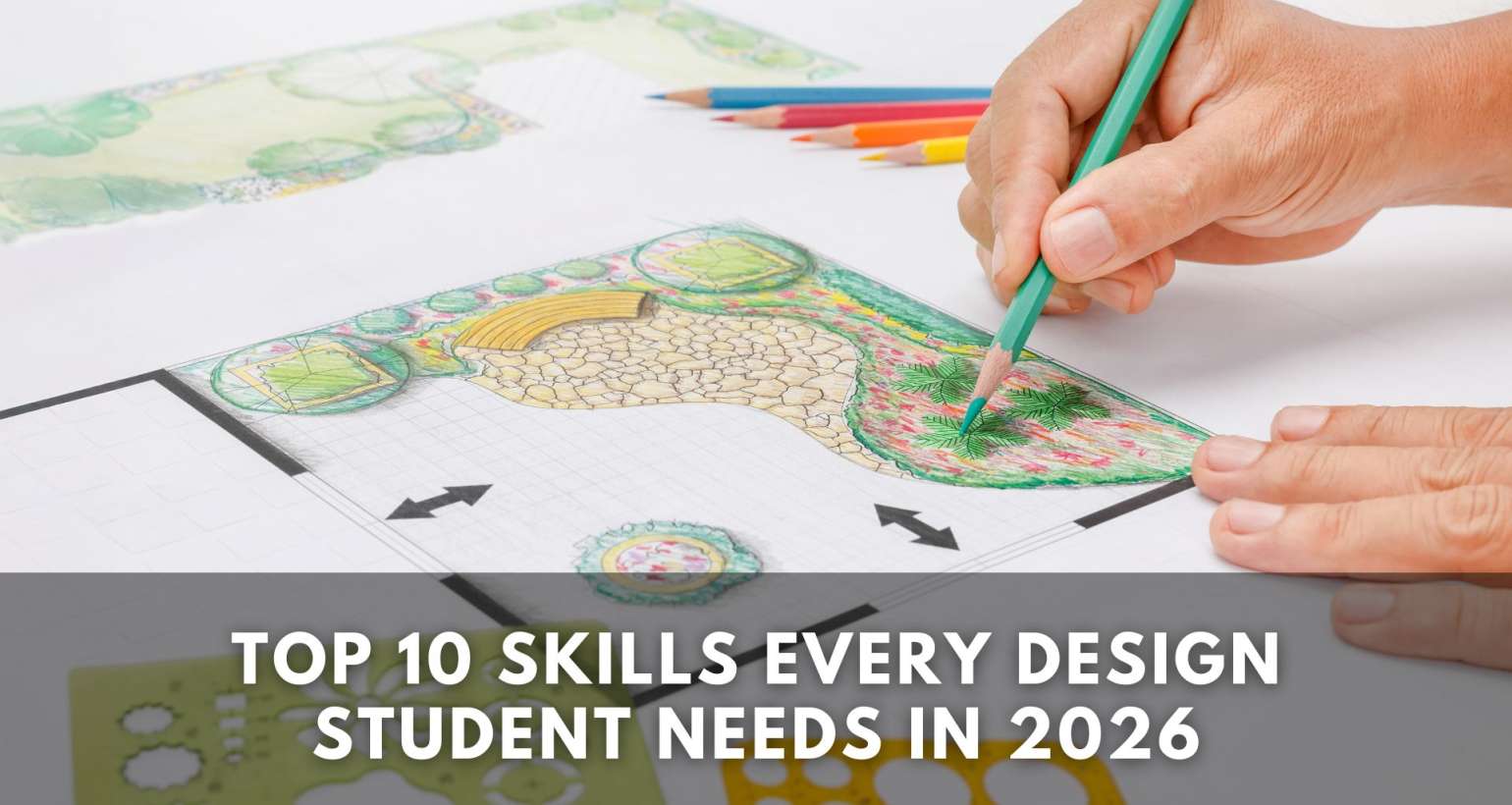
Design in 2026 is no longer limited to aesthetics or software proficiency. It is a rapidly evolving field shaped by technology, AI tools, digital media, and user-centred thinking. Hence, in order to stay relevant, students must develop a balanced mix of creativity, technical expertise, and problem-solving abilities. Strong graphic design skills today go far beyond making visually attractive work; they focus on communication, adaptability, and impact.
Below are the top 10 skills every design student should focus on in 2026 to build a strong foundation for a successful creative career.
1. Strong Fundamentals of Design
Before any software or advanced tool, the foundation of great design lies in understanding basic principles such as balance, contrast, alignment, proximity, repetition, and hierarchy. These principles determine how a viewer experiences and interprets visual information.
Even the most advanced graphic design skills fail without a strong grasp of these fundamentals. Students who understand these early can create more structured, visually appealing, and purposeful work across any medium, be it print, digital, or even motion.
2. Adobe Illustrator & Photoshop Skills
Mastery of Adobe Illustrator and Photoshop skills remains essential in 2026. Illustrator is widely used for creating logos, illustrations, icons, and scalable vector graphics, while Photoshop is crucial for image editing, manipulation, and composition.
These tools form the backbone of professional design software skills, especially in branding, advertising, and digital media. While new AI tools are emerging, Adobe software continues to be the industry standard, and employers still expect strong proficiency in both.
3. UX/UI Basics for Beginners
Understanding UX UI basics for beginners has become a core requirement for modern designers. UX (User Experience) focuses on how users interact with a product, while UI (User Interface) focuses on its visual and interactive elements.
Even basic knowledge, such as user journeys, wireframing, layout structure, and usability principles, can significantly improve a designer’s output. Today, design is not just about appearance but about how easily and spontaneously users can engage with a product.
4. Creative Problem Solving
Design is fundamentally about solving problems visually. Whether it is communicating a brand message or simplifying user navigation, creativity must be purposeful. Students must learn how to analyse briefs, understand objectives, and translate ideas into effective visuals.
Strong graphic design skills are built when creativity is guided by logic and purpose, not just how something looks.
5. Typography Mastery
Typography is one of the most powerful yet underrated aspects of design. It influences readability, tone, and emotional impact. A well-designed piece can fail if typography is poorly executed.
Students should learn how to pair fonts, control spacing, and build visual hierarchy using type. This skill is especially important in branding, editorial design, and digital interfaces.
6. Visual Storytelling
Modern design is about telling stories, not just creating visuals. Whether it is a poster, website, or social media campaign, strong design guides the viewer through a narrative.
Visual storytelling allows designers to connect emotionally with audiences, making their work more memorable and impactful. It is a key skill that separates good designers from great ones.
7. Colour Theory and Emotional Design
Colour plays a major role in influencing perception and emotion. Understanding colour theory helps designers create mood, establish brand identity, and guide user attention effectively.
In 2026, designers are expected to use colour strategically rather than based on guesswork. This includes understanding contrast, cultural associations, and accessibility considerations in both print and digital formats.
8. Awareness of Motion and Digital Design
With the rise of social media, apps, and interactive platforms, motion design has become increasingly important. Even basic knowledge of animation principles, such as timing, transitions, and movement, can enhance a design significantly.
Students who develop awareness of motion graphics and interactive design gain an advantage in digital-first industries.
9. Adaptability with Design Software & AI Tools
The design industry is constantly evolving with new platforms, tools, and AI-driven systems. Alongside traditional design software skills, students must now learn tools like Figma, Canva, and AI-based design assistants.
The ability to quickly adapt, experiment, and learn new software is now as important as mastering any single tool. Flexibility ensures long-term relevance in a fast-changing creative landscape.
10. Critical Thinking & Feedback Interpretation
Design is rarely perfect on the first attempt. One of the most valuable skills a student can develop is the ability to evaluate their own work critically and respond constructively to feedback.
Strong designers don’t just create, they refine. Learning how to improve based on critique helps build maturity and professional growth over time.
Final Thoughts
In 2026, successful designers will be those who combine strong graphic design skills, technical expertise in design software, proficiency in Adobe Illustrator and Photoshop, and a solid understanding of UX/UI basics for beginners.
However, beyond tools and techniques, what will make a major dent will be the ability to think critically, adapt quickly, and design with purpose. The future of design belongs to those who can balance creativity with strategy and storytelling with functionality.